

Pomegranate
Overview
Like most jewels, the garnet-colored arils of the pomegranate must be mined with effort and delicacy.
The skin can be scored and peeled back gently, where the arils can be loosened with careful fingers into a bowl, or sectioned and immersed in a cool bath of water and swished around until the seeds loosen on their own volition.
Or, caveman-like, just slice the fruit coarsely in half and then whack it repeatedly with a blunt object until most of the seeds fly out.
The right way to way to eat a pomegranate is the subject of much debate.
Also the subject of much debate: the myriad of health claims relating to the pomegranate.
In recent years, the pomegranate has been promoted as a panacea for many health conditions, from prostate cancer, to erectile dysfunction, to cardiovascular disease. Much of this hype was promoted by a pomegranate juice company, which has since been ordered by the Federal Trade Commission to remove these claims.
In reality, the research on pomegranates, especially using human subjects, is still in its preliminary stages.
That being said, pomegranate is likely one of the healthiest fruits available to us. This is largely due to its high content of punicalagin, an antioxidant whose value beats that of antioxidant heavy-hitters like green tea and red wine.
The pomegranate is native to Iran and grows widely throughout the Middle East, India, and the Mediterranean regions. In North America, pomegranates are often expensive and frequently unavailable, making them a rather precious delicacy.
Identification
Pomegranates are beautiful as well as delicious and are often used purely for ornamental purposes as well as culinary purposes.
On the outside, pomegranates look a little bit like an apple, except they are topped with a blossoming peaked crown on one end. Their blushing red skin is tough but smooth, almost like leather, and although the skin contains a high concentration of nutrients, it is not generally eaten because of its coarse texture and bitter taste.
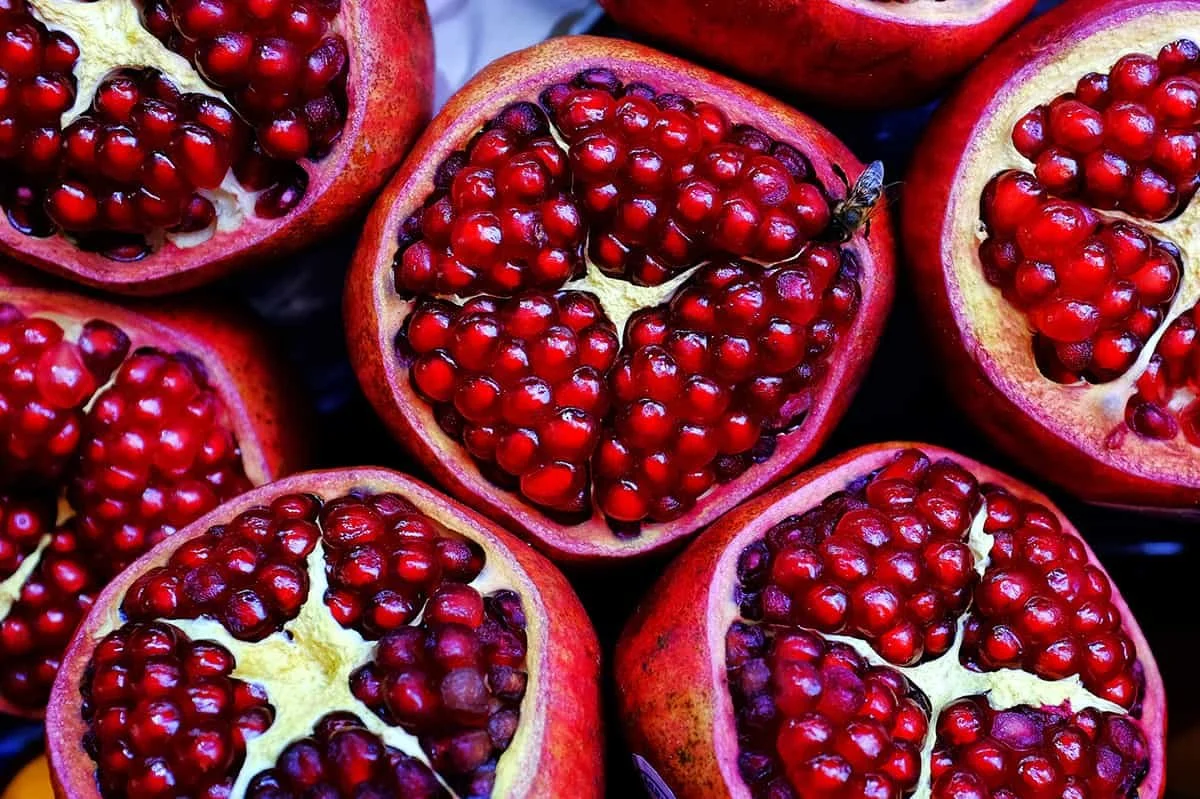
Peel the skin back and you will discover chambers of jewel-like arils, separated by translucent white membranes. The arils, which cluster tightly together, are ruby-colored juice-filled sacs, each harboring a tiny white, edible seed.
When eaten, the arils burst easily in the mouth to release a punchy, slightly tannic, sweet juice, similar in flavor to cherries. The seeds, which are nearly flavorless, add nothing but a crunchy texture.
Nutrition Info
Half a cup of pomegranate arils (about 87g) has 72 calories, 1.5g of protein, 1.0g of fat, 16.3g of carbohydrates, 3.5g of fiber, and 11.9g of sugar. Pomegranates are a good source of vitamin C.
Perhaps more interesting, nutritionally speaking, is the antioxidant content of pomegranates. Pomegranates contain a class of powerful antioxidant phytochemicalscalled punicalagins. Punicalagins, which are thought to be stronger than even the antioxidants found in green tea and red wine, are responsible for many of the health benefits of pomegranates.
Selection
Fresh pomegranates are most likely available in North America between September and January, and may only be found in larger grocery stores or specialty food shops.
Occasionally, you may find the fresh arils sold in containers, ready to eat.
Additionally, pomegranate arils may be found dried, either whole or ground, and sold as a spice in Indian or Pakistani grocery stores or specialty spice shops.
When purchasing fresh pomegranates, choose specimens that are firm, deeply colored (their color can range from deep red to reddish-brown), and heavy for their size – those will be the juiciest. Pass over pomegranates that have darkened soft spots or feel very light.
Storage
Pomegranates store well and can stay fresh in the fridge for 3-8 weeks, depending on the age of the fruit when purchased.
Pomegranate arils can also be frozen in sealed bags, where they will keep for up to six months.
Preparation
Although there are many ways to prepare a pomegranate, arguably the easiest and least messy way is the following method:
Using a sharp knife, slice off the protruding crown. Make this a fairly shallow cut, so as not to damage the arils inside. Then, score the skin in quarters, lengthwise, from crown end to the bottom.
Immerse the pomegranate in a large bowl of water, and, holding it under water, begin to peel off the outer skin, and gently separate the membrane-sectioned chambers of the fruit. Use your fingers to carefully loosen the arils from the membranes.
The seeds will sink to the bottom, and the skin and membrane pieces should float to the top of the water. Discard the skin and membrane, and drain the water from the arils.
The arils are now ready to be consumed! Finally! Sprinkle over salads or cooked grain dishes, toss them in smoothies, or just eat them by the handful!