

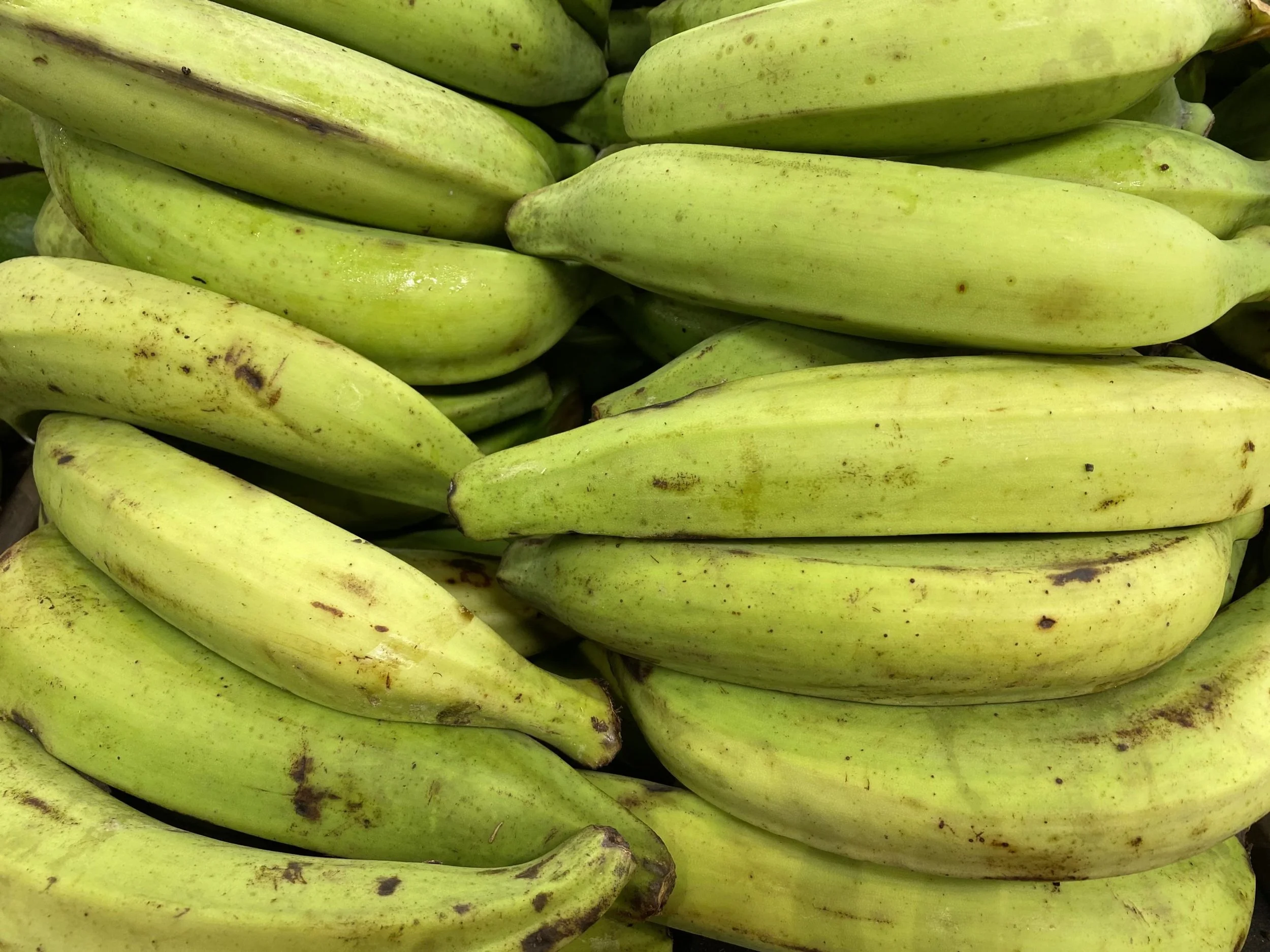
plantain
Overview
The plantain is a fruit with two faces.
The first face is presented in the very early stages of ripeness, when the skin of the fruit is green and the flesh inside is tough and starchy. The second face comes weeks later, after the skin turns from yellow to spotted to black, and inside the starches convert to sugars and the fruit becomes soft.
Most importantly, both faces are delicious.
Plantains are quite obviously related to bananas (obvious because plantains just look like big bananas), except unlike bananas, plantains are typically eaten cooked. Particularly in the early stages of ripeness (when the peel is green) plantains also have more starch and less sugar than a banana.
Plantains are native to Southeast Asia and Australia and they are a dietary staple in Africa, Central America, coastal South America, and the Caribbean islands. In these regions they are often served fried into chips or in thick slices, or boiled.
Identification
Depending on the stage of ripeness, a plantain will go through various permutations of appearance, texture, and flavor.
A green plantain is very firm and typically requires a knife to peel. Inside, the fruit is pale yellow and must be cooked in order to be eaten. Once cooked, green plantains have a dense starchy texture and a flavor similar to potatoes, with a subtle hint of banana.
A ripe plantain is nearly entirely black, and while it still holds its shape, it is very soft. As it ripens, the skin thins and becomes easier to peel, and the fruit inside sweetens and darkens to a light peach color. Ripe plantains can be eaten raw, although in the cultures where they are most popular, they are still typically cooked. At this stage, plantains will be soft and taste much more like a conventional banana. Due to the sugar content, a ripe plantain, when fried, will caramelize and produce the most wonderful flavors.
Nutrition Info
Just as the appearance and flavor of a plantain changes depending on the stage of ripeness, so too will the nutrition.
One cup of green plantains, fried in oil (about 118g) has 365 calories, 1.8g protein, 13.9g of fat, 58g of carbohydrates, 4.1g fiber, and 4.3g sugar.
One cup raw, ripe plantain (about 148g) has 181 calories, 1.9g protein, 0.6g of fat, 47.2g of carbohydrates, 3.4g fiber, and 22.2g sugar.
Plantains are a good source of vitamin B6 (pyridoxine), and in their raw form, vitamin C. Green plantains are also rich in resistant starch, a type of fiber that benefits gut health.
Selection
Depending on where you are, plantains may be sold on every street corner, or, if you are in North America, perhaps only at larger grocery stores or specialty ethnic stores.
Plantains are available whole, and they are also commonly found packaged as chips. In the latter case, read the ingredients and choose packages with little more than plantain, oil, and salt as ingredients.
When buying plantains whole (which is likely the most wholesome way to consume them), consider the ripeness you desire. If you want green plantains, choose specimens that are firm and evenly green. If you want yellow plantains, choose specimens that yield to gentle pressure when squeezed, and have a bright yellow peel, perhaps with some brown or black spots. If you want ripe plantains, choose specimens that are evenly dark brown to black and soft, yet still have integrity.
At any stage, if the peel shows signs of cracking or molding, pass it over.
Storage
Plantains may be stored as you would bananas: At room temperature until you want to halt the ripening process, at which point they may be moved into the fridge.
Green plantains, when stored at room temperature will turn very ripe in a matter of weeks.
Plantains may also be peeled and then placed in a well-sealed container or bag in the freezer, where they will keep for about six months.
Preparation
Whether you have green or ripe plantains on hand, a very traditional and most delicious way to prepare them is to fry them.
Here’s how to do it:
First, peel your plantain. If using a green plantain, a paring knife may help as the peel will be somewhat fused to the fruit. Then, cut your plantain in ¼- ½ inch slices on the diagonal. Prepare a frying pan with oil (coconut oil works well here) and heat to medium-high. When the oil starts popping, lay the plantain slices down in the pan, and cook on one side until lightly browned (about five minutes), and then flip them over to repeat on the other side. If using green plantains, you may want to squash them flatter with the back of a spatula to cook them all the way through. Once they are cooked, sprinkle them with salt and serve immediately.