

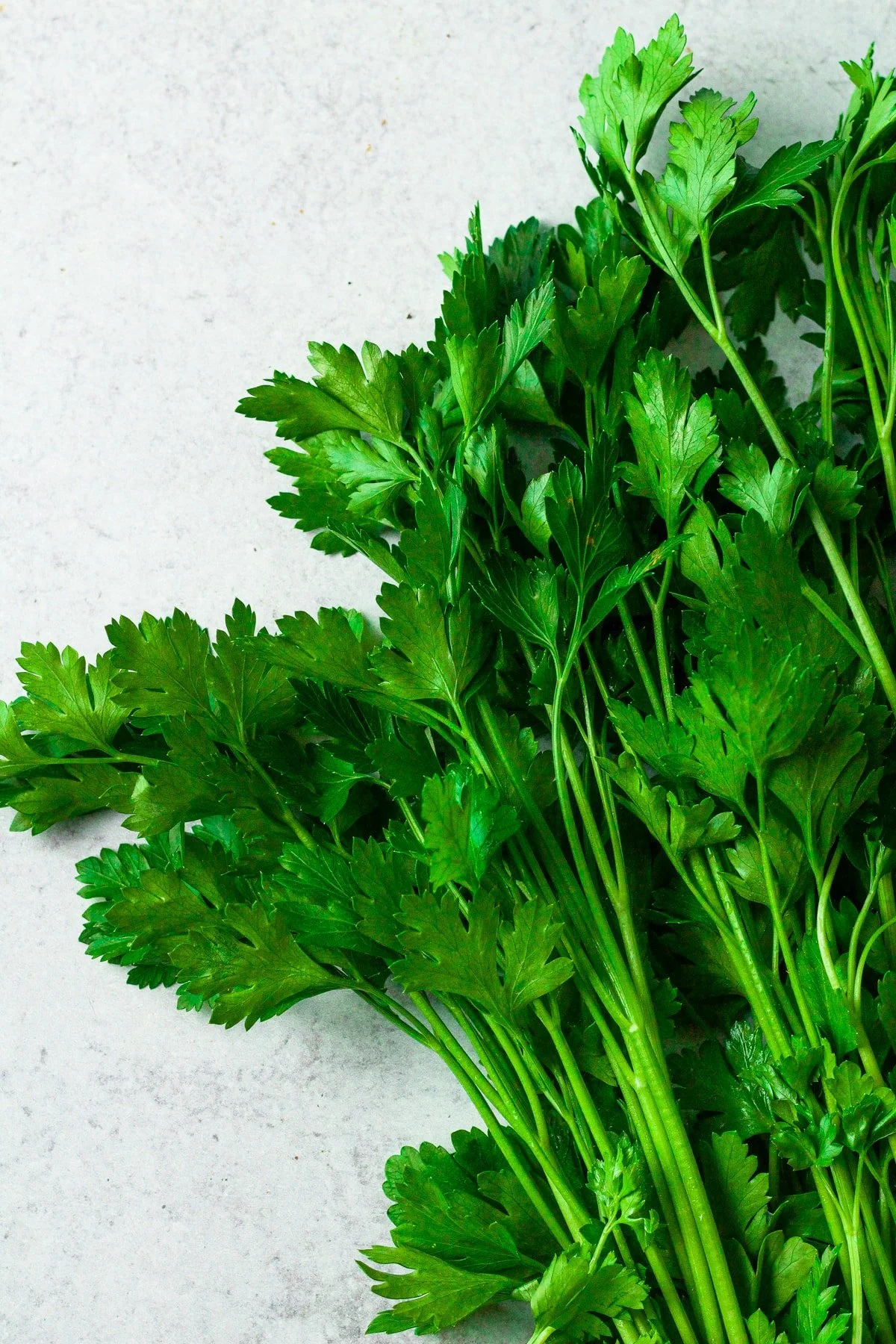
parsley
Overview
Parsley is a deeply green, leafy herb that has as much fame as a garnish as it does as a food. However it is being used, parsley is the world’s most popular herb.
Native to Mediterranean regions, parsley is part of the Apiaceae family, which also includes carrots, dill, and celery.
Two main varieties of parsley exist: flat leaf and curly leaf. As their names suggest, flat leaf parsley bears flat leaves, while curly leaf parsley bears curly, crinkled leaves. The latter is commonly used as a garnish and unfortunately cast off to the side of the plate rather than eaten.
Parsley has a history of use dating back to the ancient Greeks, where they would adorn competitors at sports games with a crown of parsley. It has a strong presence, historically and presently, in Mediterranean and Middle Eastern cuisine.
In addition to adding a vibrant, fresh flavor to a dish, parsley is also a natural breath freshener. So when presented with a meal adorned with a decorative sprig of parsley, don’t relegate it to the side of your plate. Eat it.
Identification
Parsley is a leafy herb with a deep green color. It comes in two main varieties: flat leaf and curly leaf.
Flat leaf parsley has flat three-pointed leaves and curly leaf parsley has small, ruffled leaves. Flat leaf parsley is said to have a more robust flavor, although both have a pleasantly fresh, slightly grassy, celery-like flavor. Although the stems are slightly fibrous, they are crispy and full of flavor and should not be discarded.
Nutrition Info
One cup of fresh chopped parsley (about 60g) has 22 calories, 0.8g protein, 0.5g of fat, 3.8g of carbohydrates, 2.0g fiber, and 0.5g sugar.
Parsley is an excellent source of vitamin K and vitamin C, and a good source of vitamin A (mostly in the form of beta-carotene), folate (vitamin B9), and iron.
Selection
Fresh parsley, both flat leaf and curly leaf, are widely available and can be found at most large grocery stores and fruit and vegetable markets year round.
When selecting fresh parsley, look for bunches that are vibrantly green and crisp looking. Avoid bunches that show signs of yellowing, excessive wilting, or pockmarks from insects.
Storage
Fresh parsley can last about four to five days in the fridge if stored properly. The best way to store it is to place it stems down into a glass of water and cover its leaves with a plastic bag. This will ensure that the plant stays firm and fresh and that the leaves are protected from damage from the cold.
Preparation
Although fresh parsley is rarely eaten on its own, technically it doesn’t need any special preparation (other than a quick rinse) to be eaten.
Parsley is especially delicious when chopped finely and added to salads, or added at the last minute to cooked dishes. It also makes a beautiful garnish.