

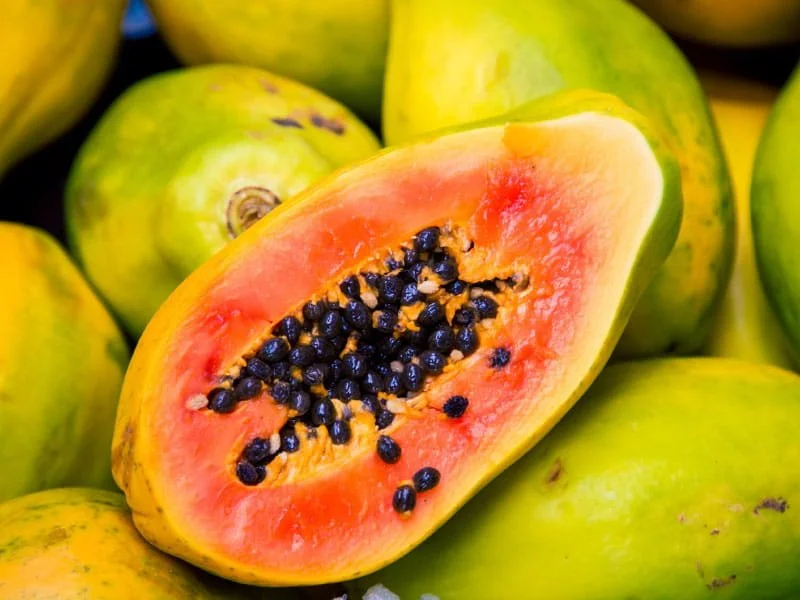
papaya
Overview
Papaya, also known as “pawpaw”, is an icon of hot-weather fruits. Sunset-colored, abundantly juicy, and lusciously fragrant and sweet, papaya is a treat from the tropics.
In addition to being beautiful and delicious, papaya is rich in nutrients and uniquely, in a compound called papain. Papain is an enzyme that has both digestive and anti-inflammatory properties, and although it is present in ripe papaya, it is found in highest amounts in the flesh of immature green papayas.
Papaya plants are interesting in that they come in three sexes: Male, female, and hermaphrodite. The male plants can produce pollen, but not fruit. The female plants can produce edible fruits, but only if pollinated. Hermaphrodite plants contain both pollinating parts and fruit-producing parts on the same flower, giving them the ability to self-pollinate and produce tasty fruits all on their own, without the complication of finding an available mate.
Papaya plants are frost-phobic and therefore can only grow in reliably warm regions. Papayas are thought to have originated from Mexico, and their home country is still among the top global producers of the fruit, following India, Brazil, and Indonesia.
Identification
Papayas are pear-shaped and when ripe, have a yellowish-orange skin mottled with specks of green.
Inside, papayas are soft and buttery with a blushing orange hue and a sweet, juicy, and slightly musky flavor. In the center of the fruit is a cavity filled with black, gelatinous seeds. Although these seeds are typically discarded, they are technically edible. Sometimes these seeds are dried and used as a substitute for pepper, given that they share a similar biting taste.
Although papayas are generally eaten ripe, unripe green papayas are also consumed. An unripe papaya will be almost entirely green on the outside, and on the inside, the flesh will be firm, tangy, and crunchy. In this state, it is delicious grated into savory dishes, such as the popular Southeast Asian green papaya salad.
Nutrition Info
One cup of ripe, raw, cubed papaya (about 140g) has 55 calories, 1.0g protein, 14.0g of carbohydrates, 3.0g fiber, 8.0g sugar, and no fat. Papaya is an excellent source of vitamin C and vitamin A (in the form of beta carotene), and a good source of folate.
Selection
Papayas are available at most larger grocery stores as imports year-round.
If you are hoping to eat your papaya immediately, choose specimens that are heavy, slightly soft, and whose skin is reddish orange. If there are large green or yellow spots, it may mean that the papaya needs a few more days to ripen.
Due to its soft skin, a few nicks, bruises, and black spots are normal. However, if the papaya is overly soft and mushy, has large areas of bruising, or shows any signs of mold, it is past its prime.
Storage
A fully ripe papaya should be stored in the fridge and consumed within two days. Alternatively, it can be cut into chunks (discarding the peel and seeds) and stored in an airtight container in the freezer for up to six months.
If you’ve purchased a sub-optimally ripe papaya and you would like to speed up the ripening process, place it in a paper bag with a banana, and leave it to mature at room temperature.
Preparation
Papayas need minimal preparation before you can put them in your mouth.
The easiest way to consume a papaya is to first cut it in half, lengthwise, and then scoop out the seeds. Then, using a spoon, you can eat the papaya scoop by scoop until you have scraped the skin, which can then be discarded.
Quick culinary tip: Elevate your papaya experience by squeezing a bit of fresh lime juice on it. Papaya and lime are friends.