

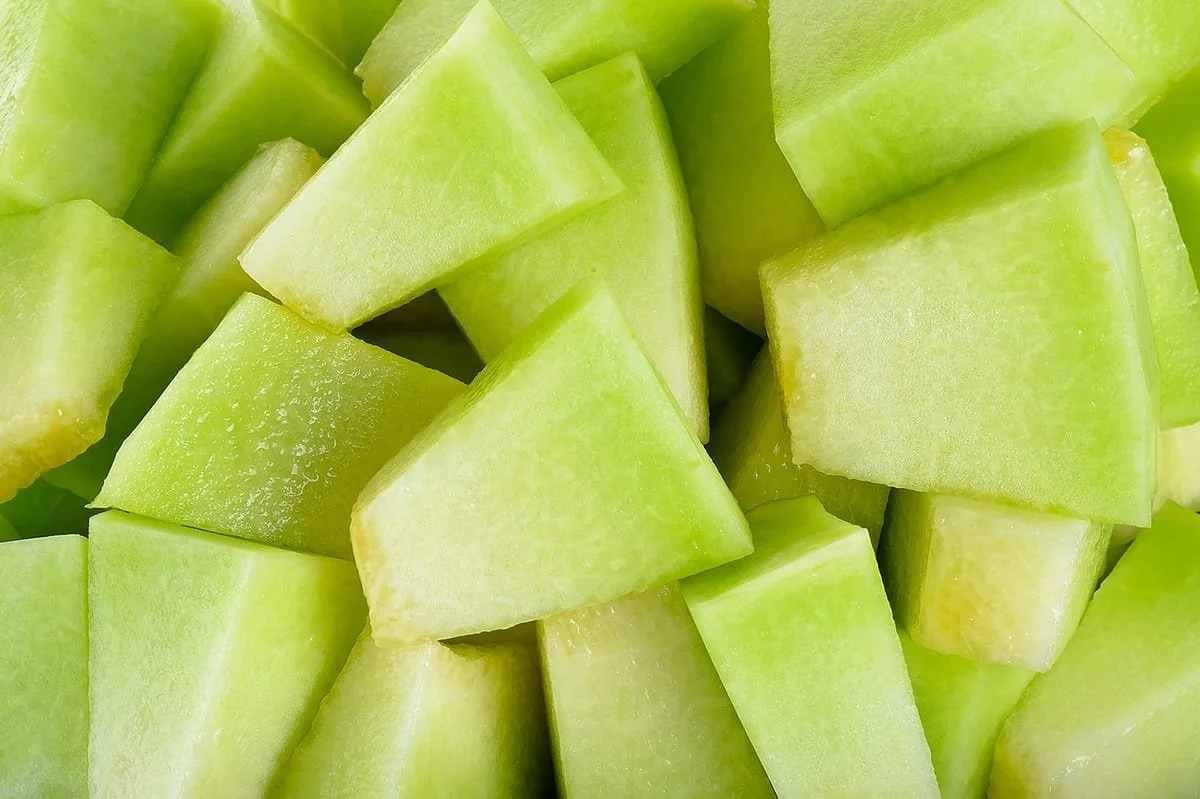
honeydew
Overview
Honeydew melon, also called honeymelon, is a pale green, sweet-tasting orb closely related to cantaloupe. Outside of North America, honeydews are known as Bailan melon (in China) or White Antibes melon (in France).
Honeydew melon is a member of the Cucurbitaceae family, which also includes squash, cucumbers, zucchinis, and other melons.
Members of this plant family can easily cross-pollinate, so there are also many different hybrid melons. For example, the visa melon is a cross between honeydew and cantaloupe: It has the yellow-beige netted skin of cantaloupe, with the smooth, pale green flesh of honeydew. Other varieties of honeydew (like “earlidew” or “cool green” varieties) are bread to mature faster or to be more resistant to fungal infections.
Because melons are prone to mold, they grow best in warm, semi-arid conditions. The process from seed to ripe and juicy consumption takes about 80-90 days. Honeydews are harvested when their skin turns from green to creamy yellow.
Identification
Honeydew melons are nearly perfectly spherical with a smooth and slightly waxy, creamy-colored skin. Inside, the fruit bears a delightfully sweet and juicy pale green flesh with a cluster of small, pale seeds at its core.
As its name suggests, honeydew has a sweet perfume and flavor of honey, with cool cucumber undertones.
Lesser known are orange-fleshed honeydews, which bear the same characteristics as a classic honeydew, but with a sunset-colored flesh.
The skin, or rind, of the melon is not eaten, nor are the seeds.
Nutrition Info
One cup of chopped honeydew melon (about 177g) has 64 calories, 0.1g protein, 0.3g of fat, 16.1g of carbohydrates, 1.4g fiber, and 14.4g sugar. Honeydew melon is a good source of vitamin C.
Selection
Honeydew melons are relatively easy to find (although they may be called different names depending on the region) at most grocery stores and fruit and vegetable markets.
Although they are often sold pre-cut and cubed, try to find a whole melon, as these will be the freshest.
Select a melon that is heavy for its size and has a waxy, smooth skin. The skin color should be greenish white to yellow, with riper melons showing more yellow. As the melon ripens further, it may develop brighter yellow splotches or brown freckles, and a sweet aroma. It will still be delicious at this phase.
Avoid honeydews with dents, bruises, soft spots, or that show signs of powdery mold.
Storage
Proper storage of honeydews will depend on how ripe it is upon purchase.
Generally, a ripe, whole honeydew will stay fresh at room temperature for up to a week. Alternatively, it can be stored whole in the fridge for up to two weeks.
Once the melon is cut, it will last in an airtight container in the fridge for up to a week, or in the freezer for up to six months.
Preparation
Honeydew melon needs minimal preparation before eating.
If you want to eat a honeydew, first wash the exterior rind with a food-safe wash. This reduces the chance of mold contamination to the flesh. Then, cut the melon in half. Scoop out the seeds and pulp, and discard. At this point, you can cut the halves into wedges to gnaw on, or slice off the rind in pieces and then chop the remaining flesh into chunks.
Honeydew melon is also wonderful when frozen and then pureed (no other ingredients needed!) to make a simple, refreshing sorbet.