

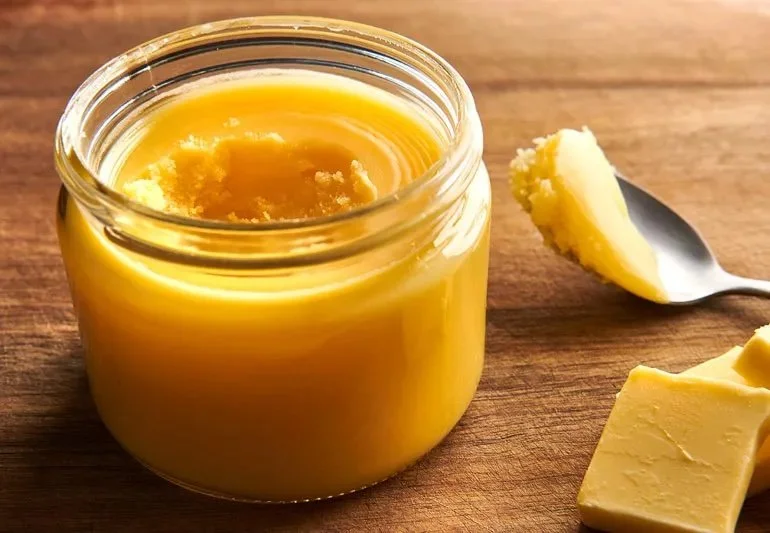
ghee
Overview
You can think of ghee as caramelized butter nectar.
Based on that description alone, you are likely now compelled to get a jar of this rich, flavorful, golden animal fat.
Ghee is ubiquitous in Indian and Pakistani cuisine, although many cultures have their own version of clarified butter. Variations of clarified butter have been used for generations, if not centuries, across Europe, the Middle East, Asia, and Africa. Depending on where you are, clarified butter may be called ghee, boiled butter, drawn butter, butterschmaltz, smen, niter kibbeh, or daigo.
There are many different cultural varieties of clarified butter, each with their own recipe or method of preparation. Some versions are cultured, some are spiced, and others are rendered from whole milk instead of butter. Cow’s dairy is most commonly used, although water buffalo or goat dairy is also used in certain regions.
Generally speaking, clarified butter is usually made by simmering butter until the milk solids, which include milk proteins (like whey and casein) and milk sugars (like lactose) separate from the fat. These solids are then strained out, and the golden liquid that remains, which is pure butterfat, is clarified butter, or ghee.
Because the milk solids have been removed, ghee is different from butter in a few important ways:
It is shelf stable. Because the sugars and proteins have been strained, bacteria has little to feed on.
It is hypoallergenic. Individuals with a dairy intolerance are generally intolerant of either lactose, casein, or whey, and only very small trace amounts of those compounds remain once strained out.
It has a very high smoke point. Ghee is excellent for high-heat cooking. Its smoke point is around 250˚C / 482˚F, which is well above most vegetable oils.
India is by far the world’s largest consumer and producer of ghee, where it is used as a food, a cosmetic ingredient, a medicine, and as part of religious rituals.
Identification
Ghee is typically sold in jars and is stored at room temperature. It is a soft, slightly granular, spreadable semi-solid fat that ranges in color depending on the type of animal it came from and the animal’s diet. Cow ghee ranges in color from pale to mid golden yellow, the darker versions usually coming from the vitamin A rich diet of grass-fed cows. Water buffalo and goat ghee are off-white.
Ghee is rich and intensely buttery tasting. If it has been cultured, it will have a mild yogurty flavor. Depending on how long it was simmered, ghee may have a mild or pronounced caramelized nuttiness.
Nutrition Info
One tablespoon of ghee (about 13g) has 112 calories, 12.7g of fat, and no significant amounts of protein, carbohydrates, fiber, or sugar. Ghee is a good source of vitamin A, vitamin E, and vitamin K, especially when from grass-fed cows.
Because ghee is an animal fat, it contains cholesterol.
Selection
Ghee can be found in good quality health food stores or Indian grocery stores.
The most nutritious ghee will likely come from grass-fed cows. Because manufacturers know that this is a selling feature, if their ghee comes from grass-fed cows, it will say so explicitly on the label. If choosing animal products that are free of antibiotics and growth hormones is important to you, choose a product that is certified organic.
As always, check the ingredients. Ghee, unless it is cultured or spiced, should only contain one ingredient: butter. If it is cultured, bacterial cultures may be listed, and if spiced, whole spices will be listed.
Storage
Ghee, after opening (or making it yourself), is shelf-stable for about one to three months, although it may last much longer depending on the brand and how it was made. If buying packaged ghee, follow the label guidelines. If making ghee at home, play it safe and discard or refrigerate after a month.
Refrigeration can extend the life of ghee to up to 12 months. However, when cooled, ghee becomes hard and difficult to spread.
Preparation
Ghee can be used directly from the jar and spread on toast, used in baking,or cooking, blended into smoothies or warm beverages, or simply eaten straight off the spoon.