

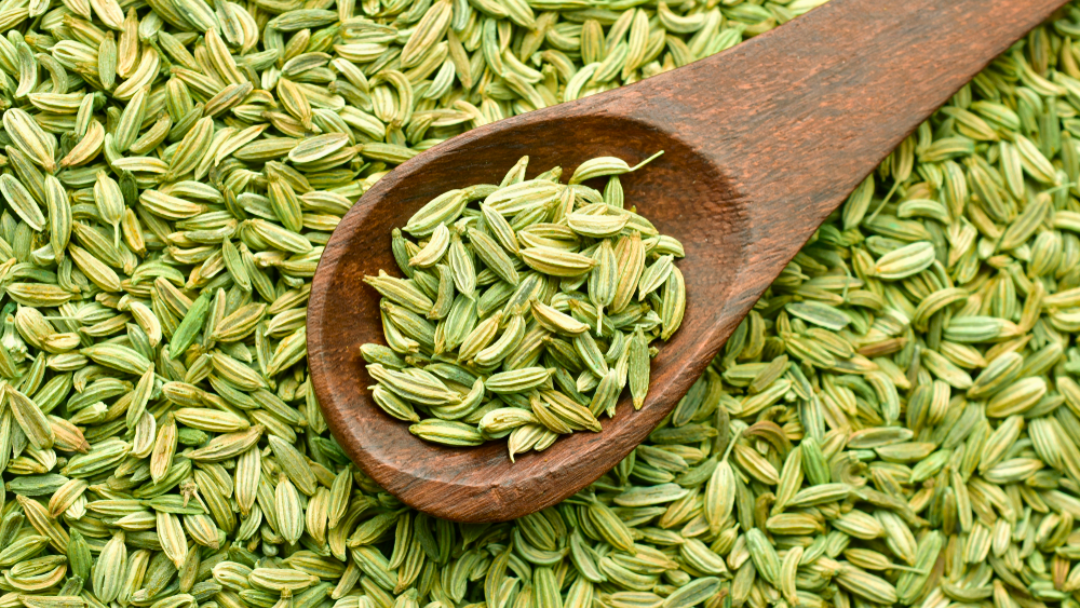
fennel seeds
Overview
Fennel, as a spice, is a small pale green seed. In this compact kernel, major flavor is found.
Much like the vegetable bulb from which fennel flowers and seeds sprout, fennel seeds have a distinctive, licorice-y taste. Around the globe, you will find pops of this sweet spice in interesting places: in traditionally made Italian sausages; sugar-coated as an edible breath-freshener in India; in the alcoholic mixture absinthe; and even as a flavoring agent in toothpastes.
Fennel is in the carrot family (which also includes parsley and dill) and grows from tiny yellow flowers on thin stems that radiate from a central stem. When the seeds are ready to harvest, the stems will dry out and turn from green to yellowish-brown. At this stage, the seeds will easily fall off the plant with a little agitation to encourage them.
Fennel grows wild in many parts around the world, particularly in North America, Northern Europe, Asia, and Australia. Fennel is such a robust (bordering on invasive) crop that it is considered a weed in Australia and the United States.
Identification
Fennel seeds are small, narrow, and pointy-ended, with ridges running lengthwise. They are a muted brownish-green and are highly aromatic. Their odor and flavor is sweet and herbaceous, with strong similarities with anise and licorice.
Typically fennel is sold as whole seeds, but it may be found as a powder as well.
Nutrition Info
Fennel, like most spices, is not a significant source of nutrition in the amounts typically consumed.
However, in herbal medicine, fennel is used to treat digestive distress such as gas, bloating, heartburn, poor appetite, and nausea.
Selection
Fennel can be found at most good quality grocery stores, health food stores, bulk food stores, and spice shops.
Ideally (and this follows the advice of most culinary experts), buy your fennel in seed form. Use the seeds whole or grind them as needed in small batches. Seeds are easily ground using either a mortar and pestle or a clean coffee mill. While you can purchase fennel already ground, it loses potency quickly in this form.
However you are purchasing it, shop at stores with high turnover, and in the case of bulk food stores, covered bins.
Whether in its ground or seed form, good quality fennel should be highly aromatic and sweet smelling. Avoid products with a weak aroma, or those that smell musty.
Storage
Keep fennel seeds or powder in a sealed container at room temperature, ideally away from heat and light, such as a closed cupboard or drawer away from the oven.
Ground fennel is particularly prone to losing potency over time. After grinding, it only has a shelf life of a few months. After this time, it is still perfectly good to eat, but it will have lost much of its flavor. Whole fennel seeds however, will stay fresh and potent for about a year.
Preparation
Fennel, as a spice, is ready to use as-is and is a delicious addition to fish or poultry dishes, cooked whole grains, pasta sauces, and many other recipes.